
Inquisitor: Something I’ve noticed about Intentional Interim Ministries, or Community Healing Ministries – as well as a lot of para-church organisations – is that their leaders are often not congregational leaders and often not active members of congregations at all. A lot seem to be in home-based churches or small, private accountability groups. Why is that? What do you make of that? I mean if I want someone to come and help me with my congregation wouldn’t I want to hire someone who is passionate about congregational church and active in congregational leadership? If the I.I. is passionate about congregational health shouldn’t they be part of a healthy congregation?
Paul: Lee, let me shoot as straight as I can on this. The church doctor or intentional interim is not there for a cosmetic clean up, but to do deep systemic work. If the church doctor or intentional interim cannot see super-clearly everything that is awry in the concept, design and functionality of congregational life today then they simply will not be able serve any congregation as a fixer. They will simply reinvent the wheel which has rolled directly into the problems that needed fixing. It would be like changing the tyres without changing the tracking. So the church doctor must needs be deeply critical! OK? So that’s point one!

Point two is that if you have a calling as a church doctor then, whatever title you carry, you will find yourself engaged with a succession of churches which need healing. What this means over the long haul is that the I.I. or church doctor is going to be continually immersed in the most painful, dysfunctional, unpleasant and sometimes quite toxic of experiences of church.
Of course a person cannot thrive in that space unremittingly. The church doctor has to be able to come home, before, during and after, to a safe space – a place of love – a place of real fellowship. That is why, as you rightly observe, so many of the Church’s specialist ministers, para-church ministers, and other trans-local servants of the church, do church for themselves in that simpler, deconstructed, more intimate, and private way. It is what the Church has traditionally called the way of seclusion / reclusion.

Historically, reform and renewal of the churches has always come from people on the edge and beyond the boundary of that scene, from people in reclusion. Think of the Moravians for instance, an extended, residential community of people who had suffered at the hands of congregational and institutional church. Hidden away in what was Czechoslovakia, it was what they carried in their reclusion, that seeded the great Evangelical Revival of the 18th century. Think…
- Melancthon and Luther, seeding the great Reformation from out of the cloisters of the monastic world.
- Patrick, Aidan , Columba, reviving mission to Ireland and England from the enclosed communities of the Celtic monastic world.
- Ignatius Loyola, vanguarding a phenomenal wave of international mission from off his sick bed in Spain and recluded in his cave just outside Jerusalem.
- Saint Anthony keeping orthodoxy on the road with the briefest of visits from his reclusion in the Syrian desert.
- The role played by role l’Abri in the 60s and 70s in the renewal American and European evangelicalism – all from a hiding place high up in the Swiss Alps.
To have that unbeholden liberty and that prophetic eye you really have to come in from the outside, or in from the edge in one way or another. That’s why I reckon that small, independent, intentional community is very often where the help comes from.
So, to put it in a nutshell, I would say, “No! You should not have any qualms about getting help for your congregation from ministries on the edge of or beyond the world of congregational church. Historically, that is the way it works.”
Inquisitor: OK let me drill into this another way then. On the Neo-Monastic section of your website you say that you say your 24 years in intentional community have “informed your approach” to Intentional Interim ministry among congregations. Let me be cheeky here and put you on the spot. Is that really a subtle way of saying that actually you see the small, intentional way as actually being superior to big church? Would that be fair to say? I would want to put it to you that there are some things that larger congregational churches will do better. Although, come to think about it, I suppose if you didn’t think that you probably wouldn’t have done this work among larger churches in the first place!
But, just for the sake of unpacking this, isn’t it a two-way street? Wouldn’t it be fair to say that, when they work well, bigger churches have plenty that can inform and enrich the smaller churches and smaller expressions?
Paul: Of course. Absolutely. But let’s get back to why congregations call on the services of Intentional Interim ministers and church doctors in the first place. One of the reasons that many congregations are struggling is that they are operating in a state of collective anxiety, which rooted in a growing awareness of decline. To generalize, in the West, congregational life is becoming less meaningful, less powerful and less significant to a growing proportion of the Church – let alone society at large.
More and more believers – not just millennials, but believers of all ages – no longer wish to express their faith or belonging in traditional congregational ways. So on the great canvas of churchianity, among the whole smorgasbord of church expressions, congregational streams are becoming less attractive and relevant to people. They are losing out – to non-attendance, to other structures, and to still other more organic forms. That’s what’s happening. That’s why, on the whole, it will be the congregations who will be on the receiving end of the equation when you talk about “informing and enriching.” This context of “shift” is why congregations right now need to be doing a lot of listening and a lot of re-imagining.
Having said all that, even in this current space, you are absolutely right, congregations still do have particular strengths and advantages. They have the advantage of strength in number to actually create new things for their communities. And that creation process is often the engine for new engagement, relevance and growth. By way of contrast, in smaller units of church, it’s more about serving and joining the local community – either through natural networks or through social or service structures that already exist. Large congregations have the option to create new structures.

Another area where I think large congregations sometimes do better than smaller units of church is in the area of recognizing people’s gifts, encouraging and equipping people. They often do a better job of honoring- and I mean that in the New Testament sense – people whose work is in ministry – I mean pastors, teachers, prophets, evangelists – maybe not evangelists – and probably not people in apostolic or pioneering ministry. But pastors, yes! In the New Testament elders were paid, and people in apostolic ministry were often paid. (Follow Apostle Paul’s writings and career and you simply cannot dispute that.) Patterns of giving and cross-subsidy enabled specialists to specialize and to sow into the life of groups and congregations translocally and at a higher level.
I think that this kind of enabling or employing culture is often stronger in the larger and denominational structures of church. Generally speaking, it is weaker in the smaller types of church.
But just to return to that background of decline-anxiety – and this relates to the whole question of professional ministry – if you leaf through a district or regional handbook for a lot of denominations, the handbook will appear very similar to how it did 20 years ago. It will be a similar list of job-titles and names next to them. What has changed (invisibly, this information probably own’t appear in the handbook) is that most of the positions on that list are no longer a means of gainful employment. Many previously full-time positions are now part-time, self-funded or house-for-duty. So just think about that for a moment. That is a very significant shift.
Inquisitor: Yes it can look a rather bleak picture can’t it. But if the big picture is og a great hollowing out, then is Intentional Interim ministry really just rearranging the chairs? Or do you think it can really change the general story of decline for congregations?

Paul: Absolutely it can! Off the top of my head I can think of numerous examples of churches which not only recovered their health from a decline, but were able to grow significantly – after a period with an I.I. If the congregation is really willing to ask the tough questions of “What is needed here?” “What is God doing in our area?” “Who lives here now and how can we serve them?” – and really be willing to see themselves as servants of those answers, then yes, even in today’s challenging landscape a church can thrive – be it a micro, middle or mega-sized church.
I think of five cases off the top of my head:
- In a town that had gained a university, an old folks church made themselves a church for the students and then over the next decade broadened into a multi-generational fellowship.
- An old folks’ church in a rural area redeployed themselves as a monthly church for kids – and then broadened into a family-church
- A church of mature ladies became a mums and bubs’ church – and then broadened from there to being a family church.
- A tiny remnant church became a ministry team to a retirement village, forming one of the most vibrant and consistent congregations in its suburb!
- An elderly remnant church became a “Let’s play” centre and then out of that grew an inter-generational “Messy Church.”
These are all churches which absolutely embraced the challenge of generational shift. They made it their mission. That’s why, often the I.I. is needed, to congratulate a church on its previous mission – which has often expired many years ago – and then envision and excite the people about their actual mission in this season.

So again I think coming in from the outside and from the edge of that world often helps bring that more flexible perspective and that edge in leading the mission forward. The I.I. is an outsider, not someone who is too deferential to what has gone before. For a parallel in the world of film, I would think of the outsider Nick Meyer, a non-Trekkie, coming in to the Star Trek franchise, somewhat annoying the old hands, but rescuing the franchise from irrelevance and launching them on the trajectory that made The Wrath of Khan the most popular Star Trek movie ever and breathed enough life into the brand to make it the most succeeful movie franchise of all time. It took an outsider to do that. Someone who “just absolutely loved everything about Star Trek” could not have done that.
Inquisitor: Is that a other reason that you see the I.I. as a short-sharp kind of engagement rather than a longer term assignment where, presumably you get more embedded in the local… glue?!
Paul: Definitely!
Inquisitor: You have been in church-based ministry for more than three decades. You have served as an Archdeacon and a theological educator. The casual onlooker might say, Paul, you couldn’t be more deeply enmeshed in institutional church. In what sense do you see yourself coming from the edge, and how has that led you to the work of a church doctor?
Paul: Yes I know it looks that way. I think… firstly I was a convert to Christianity from atheism. When I became a Christian I naively thought that the churches were motivated by reaching people beyond their walls. Therefore, presumably, they would be interested in feedback from a new convert. My reality checks came early and so I suppose I was able to see systemic problems, and the daylight between the theoretical mission and the real mission of established communities of faith. So I was simultaneously coming in from the edge and diagnosing from the get-go, so I guess that set me up.
Secondly, I remember at the age of seventeen seeing very clearly two needs in the churches. One was for pastors to have someone pastoring them, someone who wasn’t their bos, who they didn’t have to answer, but someone from outside of their immediate world who could give to them what my pastors were giving to me as a young lay-person. The other thing was for church leaderships to be able to call on specialists who could come from “other worlds” so to speak and make a surgical and strategic contribution to the equipping of the local church. Someone who could add something strategic or diagnose and deal with systemic problems. In other words a “church doctor.” I saw this modelled by people like Eddie Gibbs and John Wimber and I could clearly see the need for it.
All this lead me to praying very sincerely as a teenage believer for God to use me as a church doctor. come the time. I said, “Never send me to a church that is doing well and doesn’t need any help. Let me go to churches with problems, churches in difficulties. I am willing to go to communities like that, because I know with your help I can make a difference that way.”
I was so committed to this direction that when I was at seminary my first pastor, Bishop David Pytches, gave me some advice, which may have been some of the best professional advice I ever received. He said, “Always check a church’s books before accepting a call.” I was determined to do the opposite of that!
Inquisitor: Why??
Paul: Because I knew that would tempt me to avoid the very churches that would need me. All the churches I served as an intentional interim had structural financial problems. The most challenging was a church which was employing eight staff, half full-time and half part-time, on an annual income which could really only sustain two. When I arrived, the congregation was unaware that something like 70% of the church’s savings had been spent to meet successive annual deficits and they were now entering an eighth year of running at a loss. This is because the elders had gone seven years without worrying the congregation with facts. So the poor people in the pews thought everything was going great, and were ready for the next operational upgrade.
In previous years the church had grown on deficit financing – which is great if you’re growing. When you’re growing you over-budget and the resultant growth will meet the deficit. Only, this church was shrinking and had been for some time. Deficit financing when you’re on a decline only accelerates the decline. This is the precisely the kind of information which could have kept me from taking the gig.
Inquisitor: So an engagement like that is a pure leap of faith?
Paul: Yes it was a leap of faith in the sense that I felt very strongly guided, through various synchronicities, that I needed to put my hand up to get this church – and it was a wonderful church – around a very difficult corner. I knew it was headed for a corner, but I did not know the details of that corner, and just how sharp it was. Just as an indicator on its gradient when I arrived it was losing $100,000 US a year, every year and was 30 months away from closure – those things I only discovered once I was there and after six months had sized up the true picture.
I had actually accepted a $50,000 a year cut in remuneration from my previous position in order to take this pastorate on for a denomination that was rapidly losing congregations in that state, and I was quickly made aware that the church couldn’t really afford to pay me even that. So suddenly I was part of the problem! I guess, if I had stuck to Bishop David Pytches’ advice I probably wouldn’t have accepted that particular call. But I felt I had to go because it was a very special church, I identified with it very closely, and it absolutely deserved to survive, even if it meant traversing some choppy waters together.
Inquisitor: So once, again you come in from the outside, but then you’re in at the heart of things. You’re working with the board, the elders, the staff, the trustees, the treasurer etc. Do you keep the perspective of an outsider or do you become an insider at that point?
Paul: To make it general, if you know you’re there as an Intentional Interim, your time is too finite and your goals too discrete and defined to really allow you to become an insider. You’re there as a fixer. Your love for everyone involved must be genuine but it is ultimately a functional kind of relationship. And I find that people respond positively to the transparency of that arrangement.
On the other hand, if you are there simply with the title of Pastor and are, therefore having to address unacknowledged problems, such as in the church I just described, you may find yourself pushed to the edge of that community, whatever your own efforts or intent, simply because you are breaking taboos, shining a light on embarassing information, and presenting unwelcome truths – and so that’s what you come to represent to people, personally. You know, you’re a trouble-maker! They were happy before you made them look all this mess! So you have to be ready for that kind of push-back. So I think either way you’re not very likely to fall prey to adoption or assimilation and lose the outsider perspective when you’re tackling those kinds of issues.
Inquisitor: So then, Paul, would you say the edge or the outside is where you see yourself? Is that simply your place on the church scene? And is the edge a comfortable place to sit – long-term?
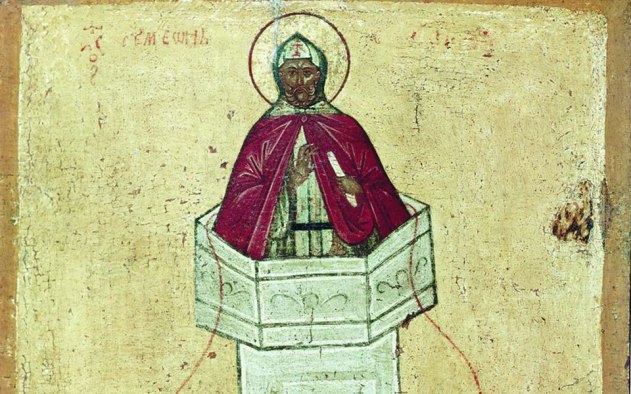
Paul: Ha ha! Yes it is where I see myself. And no, you’re right, the edge isn’t a comfortable place! -But at the end of the day, the edgy territory of the Intentional Interim or the church doctor is, I believe, a matter of calling. It’s something you’re wired for. Something made me ask for that pathway as a teenager and new believer, and one way or another my work in ministry through the decades has conformed to that hope. And, you know, the outsider-as-doctor is a time-honoured thread within the life of the Church. I think of St Anthony’s pillar on the edge of the Syrian desert. At first you think he’s all alone. But get closer and you’ll realise that Anthony’s pillar is surrounded by a number of other pillars, occupied by other stylites. Because the desert is full of those similarly wired. Even those on the edge are part of a family.

 Paul Anthony Wallis