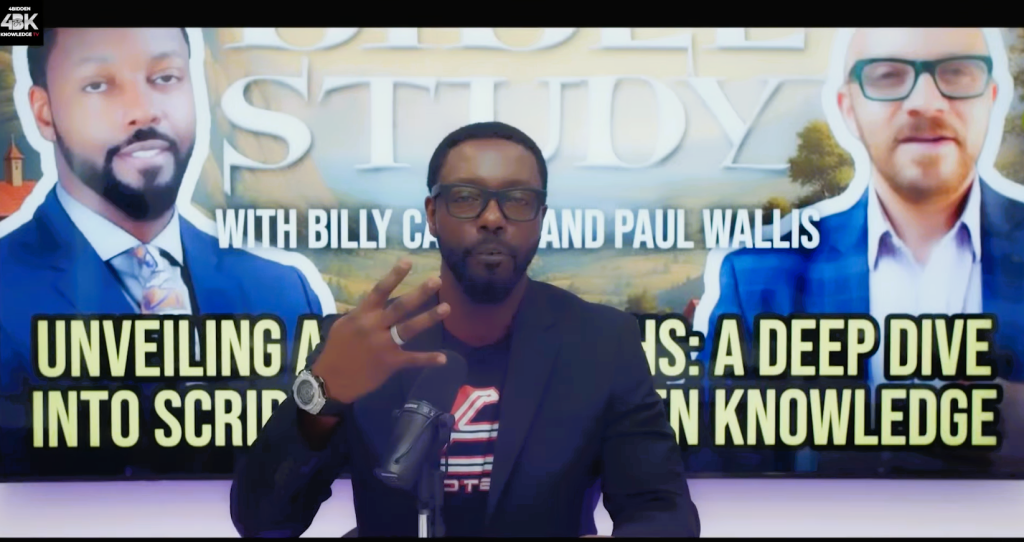
COMMENT ON THE BILLY CARSON / WES HUFF “DEBATE”
I think it is very easy to talk at cross purposes, which I think was part of what made the Billy Carson / Wes Huff “debate” such a painful watch. Classically an apologist’s job is to show the reasonableness of faith. In practice apologists can fall into a pattern which begins with a faith position, i.e. orthodoxy, and then champions data which supports that orthodoxy and finds a way to dispense with data that contradicts it. So to pitch an apologist against a seeker is a clash of agendas from the outset. So I think that dynamic was part of what made it a frustrating watch.
Billy did not do well in that conversation. I do know that Billy was very ill at that time having just been discharged from hospital with pneumonia, which he contracted while in Turkiye. You only had to look at Billy to see he was not well. He was exceptionally low energy in the conversation, unable to press his points and I think there were two points where Billy couldn’t recall the specific sources for what he was saying. Though embarrassing, I think the response from some conservative Christian podcasters has been wildly out of proportion to what actually happened, especially since Wes made mistakes too with regard to sources and textual dependence. As a Christian apologist Wes takes an interest in the dating and authorship of sources, but though he was on top of some sources (and good for him) he was dismissive of and appeared not up to date with those relating to the heterodox topics Billy was interested in discussing.
I would have liked to have heard Billy and Wes discuss the topic of Jesus’ possible relationship with Mary Magdalene. I find it interesting that there were early Christian communities who believed in this relationship and evidently had no problem with it. Unfortunately when Billy cited the new fragment known as “The Gospel of Jesus’ Wife,” initially Wes Huff claimed not to know what text Billy was talking about. When it became clear it was the Karen King fragment that Billy Carson was referencing, Wes dismissed it, asserting that it had been debunked. To be fair, Wes may have believed that it had been debunked but that is in fact not the case. Harvard Professor Karen King’s work was backed up by Harvard’s analysis of the fragment and by Professor Roger Bagnall at Yale. The age of the fragment has been questioned and its apparent dependence on the Gospel of Thomas has been noted. However, these points do not falsify the fragment, they only inform us. The Harvard review concluded from its analysis that no evidence of fakery or forgery had been found and to date it has not retracted that position.
In the end, though, whether or not you accept the Karen King fragment, the fact is that the “Gospel of Jesus’ Wife” only goes a degree further than what we already have in other extra-canonical texts such as the Gospel of Mary Magdalene, the Gospel of Philip and Pistis Sophia,. They all describe an intimate, romantic relationship between Jesus and Mary (Magdalene) and a degree of friction between Peter and Mary, with the former being jealous of the latter’s access to more privileged information. I find that interesting, not from the point of view of proving “what really happened,” but out of an interest in the spectrum of belief among early Christians (those sources are from the 200sCE) and the widespread comfort at that time with a picture in which Jesus had a girlfriend or even wife. Frustratingly the moderator lost the point in the disagreement over the validity of the “Gospel of Jesus’ Wife” fragment and failed to move the conversation forward onto the actual topic.
I find it interesting that orthodoxy has such a huge problem with even the idea of Jesus in a relationship. It in no way impacts my value of Jesus’ person or teaching. But for some it certainly seems to be hot potato. But as NT scholar Bart Ehrman said just the other day, “Does it really matter?”
I would also like to have heard Billy and Wes discuss the question of early Christian communities such as those which produced and read Thomas, Q and the original form of Mark’s Gospel (to be found in the Codex Sinaiticus, popularly referred to as the Sinai Bible) which had a theology variously absent of resurrection, resurrection appearances, crucifixion and ascension narratives. How were those themes not important to these Christian writers / communities? Initially Wes Huff claimed not to know what Billy Carson meant by the Sinai Bible. However, once it was established that he was talking about the form of Mark in the Codex Sinaiticus, again the moderator didn’t move the conversation forward onto the actual question. So again, very frustrating. My view is that the earlier version of Mark has a kind of resurrection ending with a statement that Jesus has arisen and will be seen in Galilee. My take, however, is that this is actually an ascension-type narrative – as is the passage in I Corinthians 15, where Paul equates his subjective resurrection encounters with those of the Twelve. It is important to note that Paul did not claim to encounter a flesh and bone human being. Indeed Paul argues that after our bodies die we continue as spiritual entities with a “spiritual body.” And that is how he understands Jesus’ resurrection too.
The empty tomb of proto-Mark fits neatly into the trope of the apotheosis of the hero, common to Graeco-Roman mythologies. That was the world of the first readers of that text. I would have loved to have heard this discussed. Unfortunately, once again the moderator never moved the conversation onto that point for Billy and Wes to compare notes, which was a shame because I would have liked to hear a conversation on that topic.
My interest in Christian sources differs to that of an apologist. Wes Huff is concerned to establish what he believes can be demonstrated as history and then argue for the truth of orthodoxy, built on that historicity. I can understand that. However, my interest is in going back and giving a “second listen” to the full kaleidoscope of primitive and early Christianity, from the time before its imperialisation and orthodoxisation. I guess I am more of a radical that way! As to historicity, though, I would also have liked to have heard Wes Huff’s response to the problem of the lack of eyewitness or contemporaneous reportage of Jesus, which was one of the salient points Billy raised. The closest we have to that is the desciptions of ealry Christin belief and practice by Tacitus, Suetonius, Pliny and Josephus, but they are one or two generations removed from the claimed events. I think this is one of the most important problems Christianity has to address in its apologetics. Frustratingly, Wes’ feed dropped out at that point, and the moderator never brought the conversation back to that point.
As to the dependence of the Bible on the Mesopotamian cuneiforms, this is something that has been well established since the 1800s and has been a matter of more public conversation since the 1870s when Assyriologist George Smith publised “The Chaldean Account of Genesis.” Some of the correlations are in matters of considerable detail. In the academic community this is in no way a controversial point so iI was very surprised when Wes Huff would not acknowledge the point. Anyone with even a Bachelor’s Degree in Theology has to study this dependence as part of their degree. At an academic level, where the controversy lies is around precisely what that dependence means. What are its implications? It would have been interesting to have heard these questions discussed, but unfortunately the moderator didn’t hold the conversation on topic long enough for that to happen.
In the end, Billy tapped out and went home and asked his friend not to air the conversation because he knew he had not done himself justice. The “friend” however ignored Billy’s requests and put it to air anyway, at least until Billy hand-delivered a formal cease and desist. Only then did he take it down. By this point Wes had already posted it on his own YT channel and other YouTubers immediately re-published it on their own platforms. To me that’s a regrettable scenario. Why would you do that to a person, let alone a friend? If I have a guest on The 5th Kind or the Paul Wallis Channel it is to give them an opportunity to speak, not to trap them. That’s my view.
When in the past people have asked me to do a “debate” or a “response video” in order to “debunk,” or “expose” some other writer, or a researcher, or a YouTuber who takes a different view to me, I have just said “No.” Because why on Earth would I do that to a fellow seeker or a fellow broadcaster, whether or not we agree, be that Billy Carson, Wes Huff or anyone else?
Billy’s initial video response was unfortunate The attacks on him – which included physical intrusion into his place of residence, and physical threats against his family – had pushed Billy into a bad space and his initial response video showed at his worst as he addressed very specific people, who had abused his trust for the sake of clout-chasing. It was certainly an ugly moment. Would you or I want to be judged by our worst moment? Billy then took the video down, made a public apology and got himself some counselling, and he shared some of that conversation on his platform. Regrettably some content creators see all this as grist for the mill and use their own negative judgements of people in the public eye as a bid for views. I find that a shame. If our agenda is to understand the other, then I don’t find debates a very productive way to go about things. By their nature, debates polarise the speakers so that there is no real incentive to to deeply listen to nor understand the other speaker. Instead it’s all about finding ways to “beat” your opponent. And of course debates polarise the audience, which is also unhelpful as there are likely to be strong points and weak points on both sides. I think that rather than pitching one “expert” against another or one YouTuber against another, it is better that we listen critically to any speaker and then be willing to go away and do our own thinking and reading. That’s my take.
I hope that’s helpful.
Health and Peace,
Paul
 Paul Anthony Wallis