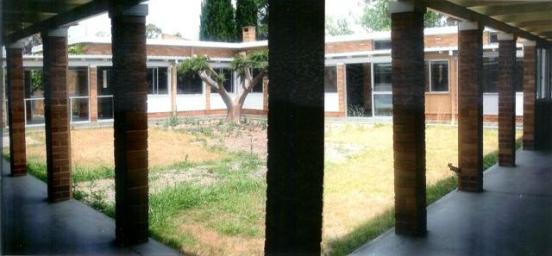
A Cloister, home for a time to Jesus Generation – Yarralumla, Australia
JESUS GENERATION’S ROOTS
Over 24 years – from 1985 to 2009 – I shared life in various degrees of community with a sequence of Gen-Xers and Gen-Ys. This journey was catalyzed by my studies in church history which led me to some often neglected threads in the fabric of the Christian tradition – those of Covenanted Fellowship and Intentional Community. My study of old ways led me to a way of life which for me was quite new. Between 1997 and 2009 I pioneered a sequence of local communities and an international network of associate members. The life of our network centered on the hospitality of group-houses andorganized around a shared pledge to the apostolic life. We called this network “Jesus Generation” or “JGen” for short.
A sequence of 66 brothers and sisters played their part in developing JGen’s patterns of life. These patterns were reflected in a rule of life called the Travellers Guide. This constitutional basis enabled us to operate as a network of local autonomous groups. In time JGen included members in the UK, Australia, New Zealand and South Africa. .
JESUS GENERATION’S LIFE
The Travellers Guide centred our rhythm of life on relational and hospitality-based ministry, focusing our time and energy towards those outside the realm of church circles. In this way we reached, befriended, pastored and taught not gathered congregations, but those among the 95% who might never attend a church venue or program, nor have any interest in doing so. Hence in its 12 years of life and ministry, JGen never once ran a church service. (This is a boast I am very proud of!!)

Home for a time to JGen Garran – Australia
(aka ‘The Ranch’ in my book The New Monastic)
Our watchwords were hospitality-based ministry and household-based church. In our scattered life we occupied the worlds of education, chaplaincy, care, respite care, broadcasting, adult education, ethical business and trades. So although we were a small expression of church, our involvement in the community and the larger Christian scene was wide.
Our shared life was expressed in sharing food together, and enjoying the amazing pastoral power of receiving people into a hospitable home – something our households did on a weekly basis. Our pattern of hospitality included a rhythm of l’Abri Sundays (so-called because they were modeled on the rhythm of life at l’Abri UK). These days consisted of a morning quiet reading, then making and eating lunch together, then in the afternoon some hard yakka on the land for the blokes while the girls enjoyed some girl time. We found these great settings to bring friends to who wanted to check us out.
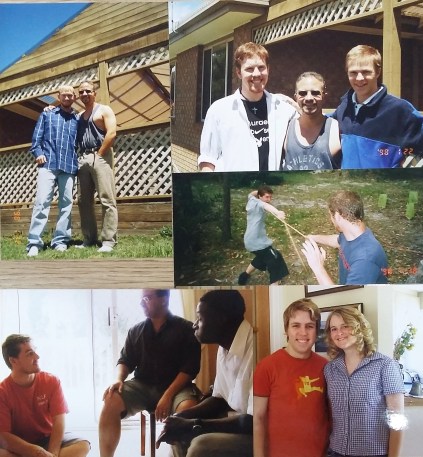
 Some JGen Australia scenes 2003-2009
Through the dual emphasis of scattered life plus hospitality, we saw many people in our expanding natural networks introduced to the teaching and ways of Jesus. Because we operated without the industrial-scale overheads associated with large buildings, we found that we were able to give away significant sums of money. It was a great joy to use our shared purse for anonymous benefactions, Christmas hampers, and gifts to poor families in our area as well as development work overseas. Each quarter we would gather to work out who and what we could bless with our group’s shared purse! It was a favourite activity.
JGen‘s spirituality was not centered on a passive vision of Jesus receiving our service and worship. Instead our spirituality was oriented around the apostolic life modelled by Jesus, his Twelve and his Seventy-Two. We saw our emulation of apostolic life as something active and intentional. This insight was sparked for me by my exposure to:
- Amazonian “ecclesiogenesis” (grassroots church) in the ’80s
- Cell-Church practitioners in Asia in the early ’90s
- Personal Study of exemplar pioneers through church history


(Above top) Paul, learning the mechanics of the cell-church phenomenon in Asia with Pastor Sengh Li of Singapore’s Faith Community Baptist Church in the 1990s and (above) sharing life with some catalysts of Amazonia’s ecclesiogenesis at the Regional Pastoral Institute in Belem, Brazil in the 1980s
SAFE CHURCH PRACTICES
When JGen has been running for ten years we noticed that 80% of our members were employed in the world of education. With others involved in secular-care work and para-church ministries it meant:
88% of JGen‘s membership was Police Checked, WVP Checked and Working with Children Checked. This put our network more than a decade ahead of the curve in terms of safe church practices. (Something else I am very proud of.) We also noted at one point that
20% of our network had, or were working towards, Theology degrees. This reflected a theological literacy within our number that was very high.
FROM FRINGE TO FOLD
Despite these distinctions, because we operated a model of church very different to mainstream conventions at that time, we found JGen to be often prejudged with a high degree of suspicion – and sometimes open hostility – by Christian and ministry brothers and sisters. For much of our first decade we found that we needed a very thick skin and a generous measure of grace. Thankfully this began to change through the enthusiasm of significant public figures – such as Phyllis Tickle, Archbishop Rowan Williams, Mike Frost, Alan Hirsch and Archbishop Justin Welby. Through their work, principles of Intentional Community and New Monasticism began to reappear in the mainstream conversation of the Christian world.
GETTING BACK TO OUR ROOTS
After JGen’s first decade we re-visited our rule of life as a network to review it and revise it against our lived practice. Originally our rule was borrowed from the constitution of an Anglican monastic community in the UK, which for many years was my spiritual home from home,The Community of the Servants of the Will of God under the leadership of the Father Superior, Father Gregory (a.k.a.Revd Edward Dudding.) It was only as we undertook the work of reviewing our constitutional document that we came to appreciate that our rule of life was essentially the “Little Rule for Beginners” crafted by Benedict of Norcia in the 500s AD!! No wonder it had served us so well!!

We were also struck by close parallels between our lived praxis and the “Declaration of Faith” – the first manifesto of Baptist Christianity – penned by Thomas Helwys in 1611. These Baptist parallels did not arise through any deliberate emulation. Rather, the parallel patterns were found organically as a community as we made a similar journey to our Baptist forbears and arrived at similar conclusions.
 Paul Anthony Wallis